

What is chamomile good for? Chamomile is one of the world’s most familiar medicinal plants, traditionally associated with digestive comfort, relaxation and quiet moments of everyday care.
But before exploring its possible benefits, there is an important distinction to make: chamomile does not always refer to the same botanical species.
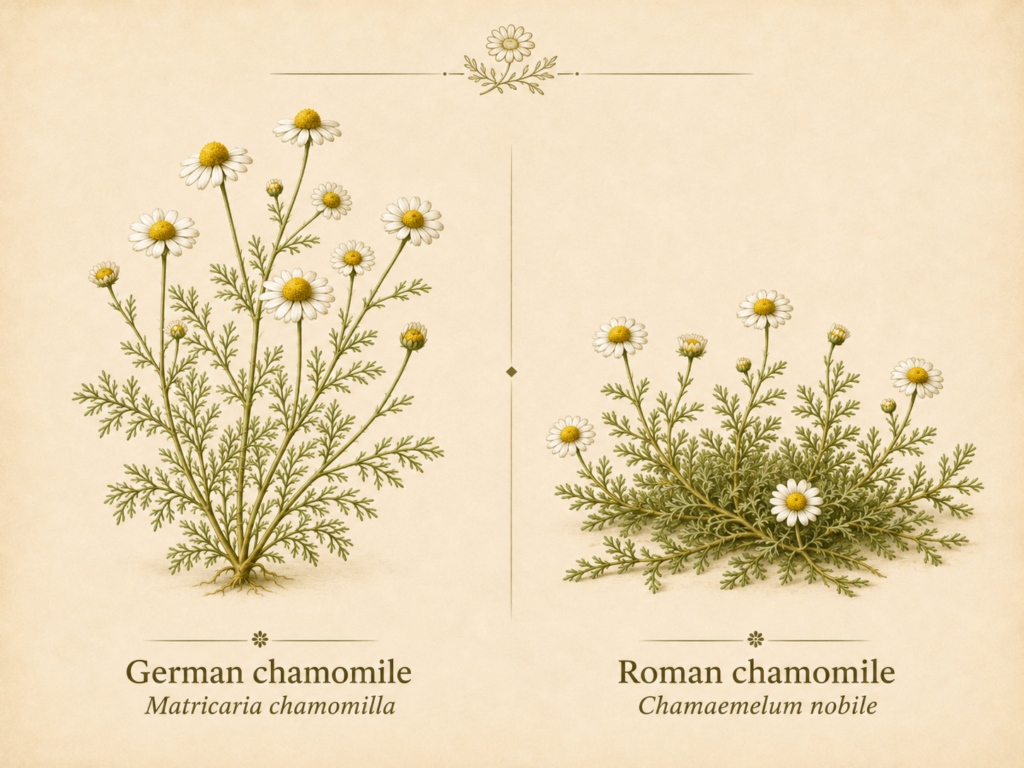
This article focuses on German chamomile (Matricaria chamomilla L.), also known in scientific literature as Matricaria recutita. Roman chamomile (Chamaemelum nobile) is a different species, with its own characteristics and traditional uses.
German chamomile flower preparations have a long history of medicinal use. European regulators recognize certain traditional applications for minor digestive complaints, symptoms of colds and specific conditions affecting the mouth, throat and skin.
Researchers have also investigated chamomile extracts for anxiety and sleep. However, the findings vary depending on the preparation, the condition studied and the quality of the available evidence.
Traditional use, results from a clinical trial involving a standardized extract and the effects of a cup of chamomile tea are not interchangeable.
In this Benverde guide, we will explore what chamomile is traditionally used for, what modern research suggests and which precautions deserve attention.
Quick Summary
| Question | Quick Answer |
|---|---|
| What is chamomile good for? | Certain preparations have recognized traditional uses for minor digestive complaints and specific applications involving the mouth, throat and skin. |
| Which chamomile? | Matricaria chamomilla L., also known as Matricaria recutita. This is German chamomile. |
| Does chamomile help with anxiety? | Some clinical studies of standardized extracts suggest possible benefits, but the evidence remains preliminary. |
| Does chamomile improve sleep? | Research suggests improvements in certain measures of sleep quality, but chamomile is not a proven treatment for insomnia. |
| Which plant part is used? | Mainly the flower heads, which contain numerous small individual flowers. |
| Are tea and extract the same? | No. Herbal teas, standardized extracts and essential oils differ in chemical composition and concentration. |
| Main safety concerns | Allergies to related Asteraceae plants, possible medicine interactions and limited safety information during pregnancy and breastfeeding. |
🌿 What is Chamomile?
Matricaria chamomilla L. is an annual flowering plant belonging to the Asteraceae family, which also includes daisies, sunflowers and marigolds.
According to Plants of the World Online, maintained by the Royal Botanic Gardens, Kew, the species is native to a broad geographical range extending from Macaronesia and North Africa through temperate Eurasia to parts of Asia.
What appears to be a single small flower is actually a flower head composed of numerous individual flowers.
The white outer structures are ray florets, while the yellow center consists of many smaller tubular disc florets.
In herbal medicine, the flower heads are the principal plant material used to prepare infusions, extracts and other medicinal products.
The European Medicines Agency (EMA) evaluates specific preparations of these flower heads under the name Matricariae flos.
Understanding the botanical identity and the preparation used is essential when interpreting information about chamomile.
German Chamomile and Roman Chamomile Are Different Plants
Two botanical species are particularly well known under the name chamomile:
German chamomile — Matricaria chamomilla L.
Roman chamomile — Chamaemelum nobile (L.) All.
Both belong to the Asteraceae family, but they are classified in different genera.
The Royal Botanic Gardens, Kew, maintains separate botanical records for German chamomile and Roman chamomile.
Although these plants share familiar names and some traditional applications, they should not be assumed to have identical chemical compositions or medicinal properties.
This article deals specifically with German chamomile.
What Is Chamomile Traditionally Used For?
Chamomile has been used in traditional herbal medicine for a variety of purposes.
The European Medicines Agency recognizes certain preparations of German chamomile flower heads for uses based on long-standing medicinal tradition.
These include:
Relief of minor gastrointestinal complaints, such as bloating and mild spasms.
Relief of common cold symptoms, using appropriate preparations.
Minor inflammation and ulcers of the mouth and throat.
Certain mild skin irritations and inflammatory conditions.
Superficial wounds and small boils, within the conditions described in the monograph.
These are not general recommendations for every product containing chamomile.
The recognized applications depend on the preparation and the route of administration.
Moreover, traditional-use recognition does not mean that clinical efficacy has been conclusively demonstrated.
The EMA considers the history of medicinal use and the available scientific evidence when evaluating these applications.
Chamomile and Digestive Comfort
Digestive comfort is one of the best-documented traditional uses of German chamomile.
The EMA recognizes specific flower preparations for the relief of minor gastrointestinal symptoms, including bloating and mild intestinal spasms.
This helps explain why chamomile infusions have historically been associated with moments after meals and occasional digestive discomfort.
However, the word minor is essential.
Traditional digestive use should not be interpreted as evidence that chamomile treats gastritis, ulcers, irritable bowel syndrome or persistent abdominal pain.
Severe or recurrent symptoms, persistent vomiting, bleeding, fever or significant abdominal pain require professional medical assessment.
Chamomile should not be used to delay the diagnosis of a potentially serious digestive condition.
Chamomile, Relaxation and Anxiety
Chamomile has a strong cultural association with calmness and relaxation.
A warm infusion can be part of a personal ritual that encourages someone to slow down and take a quiet moment.
But researchers have also investigated whether specific chamomile preparations might influence symptoms of anxiety.
In a randomized, double-blind, placebo-controlled trial published in 2009, 57 participants with mild to moderate generalized anxiety disorder were assigned to receive chamomile extract or placebo over eight weeks.
The researchers observed a modest but statistically significant improvement in anxiety symptom scores in the chamomile group compared with placebo.
This was an encouraging finding, but the study was relatively small.
Additional trials have examined standardized chamomile extracts, although their results do not yet establish a reliable treatment for anxiety disorders.
The National Center for Complementary and Integrative Health (NCCIH) describes the evidence as preliminary.
There is another important detail: these trials evaluated specific extracts, not ordinary homemade chamomile tea.
Therefore, the most responsible conclusion is:
Certain chamomile extracts have shown promising results in anxiety research, but this does not prove that drinking chamomile tea treats an anxiety disorder.
The traditional experience of a calming evening ritual can coexist with scientific investigation without being presented as a medical treatment.
Does Chamomile Help With Sleep?
Chamomile tea is closely associated with bedtime in many cultures.
However, relaxation, feeling sleepy, improving perceived sleep quality and treating insomnia are different outcomes.
Earlier reviews found little reliable evidence for chamomile as a treatment for insomnia.
More recently, a 2024 systematic review and meta-analysis examined 10 clinical trials involving 772 participants.
The researchers found improvements in certain measures of subjective sleep quality. Some studies also reported improvements in falling asleep or remaining asleep.
However, the findings were not consistent across all outcomes.
There was no reliable improvement in total sleep duration, sleep efficiency or daytime functioning. The trials also differed in their methods, participants and chamomile preparations, and several had important methodological limitations.
These findings add useful information to the scientific discussion.
They suggest that chamomile may influence certain aspects of perceived sleep quality, but they do not establish it as a proven treatment for insomnia.
The evidence also does not justify assuming that an ordinary cup of chamomile tea will reproduce the results of every preparation investigated.
For someone who enjoys chamomile as part of an evening routine, the ritual may still be meaningful.
A relaxing habit does not need to be a clinically proven insomnia treatment to have a place in everyday life.
Chamomile for the Skin, Mouth and Throat
German chamomile is not used exclusively as a drink.
The EMA recognizes certain traditional medicinal applications involving the mouth, throat and skin.
These include specific preparations for minor oral inflammation and ulcers, as well as mild skin irritation, superficial wounds and other limited conditions described in its assessment.
However, preparation matters.
A formulated mouth rinse, an ointment, a liquid extract and a homemade infusion may differ considerably in concentration, composition and safety.
A product intended for the skin should not automatically be used inside the mouth, and a preparation intended for oral use should not be assumed suitable for other applications.
Serious infections, extensive wounds and persistent inflammation require professional evaluation.
Can Chamomile Tea Be Used on the Eyes?
Using chamomile tea bags or homemade infusions around the eyes is a familiar traditional practice in some households.
However, homemade chamomile preparations should not be used as eye drops or eye washes.
A clinical report published in 1990 described allergic conjunctivitis associated with chamomile eye washes.
In addition to the possibility of irritation or allergy, homemade infusions are not sterile ophthalmic products.
Eye symptoms should be evaluated and treated with products appropriate for ocular use.
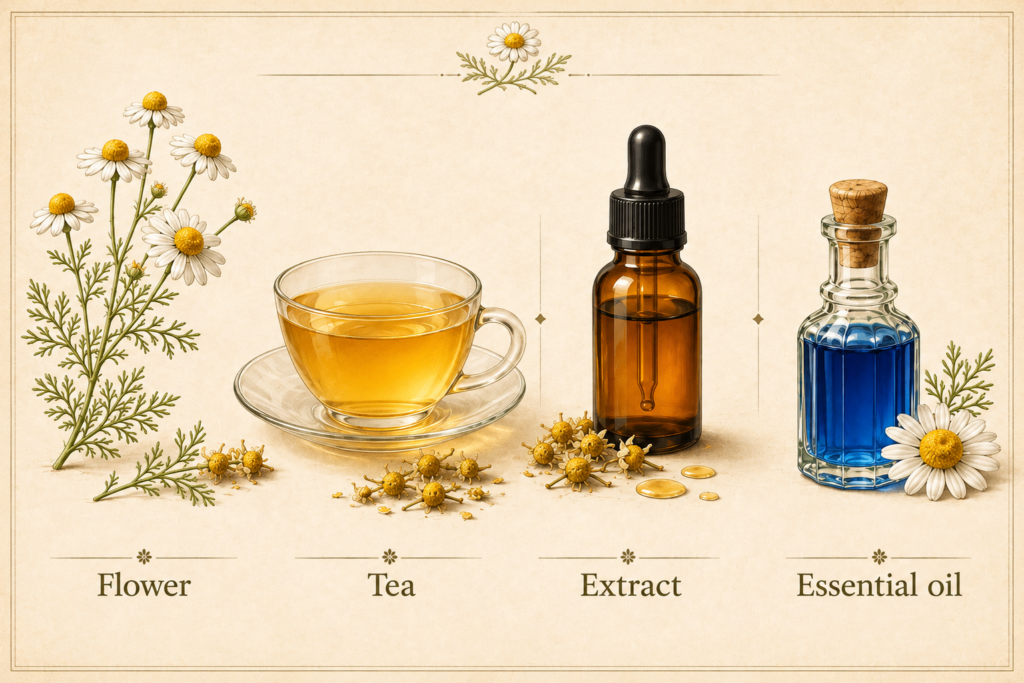
Flower, Tea, Extract and Essential Oil Are Not the Same
One of the most common mistakes when discussing medicinal plants is assuming that every preparation has the same properties.
German chamomile can be used in several forms.
Dried Flower Heads
Dried flower heads are the botanical raw material used in traditional infusions and in the manufacture of various herbal preparations.
Their quality depends on correct botanical identification, proper processing and suitable storage.
Herbal Tea or Infusion
Chamomile tea is prepared by allowing hot water to extract some of the constituents present in the flower heads.
Not every compound found in the plant is extracted into water in the same amount.
Standardized Extracts
Herbal extracts are produced using specific solvents and manufacturing processes.
Their composition and concentration may differ substantially from those of a household infusion.
Clinical studies of anxiety, for example, have used carefully prepared chamomile extracts.
Essential Oil
Chamomile essential oil is a concentrated mixture of volatile constituents obtained through distillation.
It has a different chemical profile from a water-based infusion.
Some German chamomile essential oils have a characteristic blue color associated with chamazulene, which forms primarily through chemical transformations during distillation.
Essential oil is not simply a stronger version of chamomile tea.
Its concentrated nature requires separate safety considerations, and it should not be ingested or applied indiscriminately.
The key principle is simple:
Evidence obtained from one preparation should not automatically be transferred to another.
What Does Science Say About Chamomile?
Modern research presents a more nuanced picture than the simple question “Does chamomile work?”
Different studies have investigated different preparations, participant groups and health outcomes.
The available evidence can be understood through three broad categories.
Traditional Medicinal Uses
Certain preparations of German chamomile flower heads have documented traditional uses for minor digestive complaints and specific applications involving the mouth, throat and skin.
The EMA’s recognition is based primarily on long-standing use rather than conclusive clinical evidence.
Promising but Limited Clinical Findings
Standardized chamomile extracts have shown encouraging results in some clinical studies involving anxiety.
Research on sleep has also identified improvements in certain subjective outcomes.
However, these findings remain subject to limitations, including small studies, differences in preparations and methodological concerns.
Claims That Are Not Established
The available research does not justify claims that any chamomile tea can reliably treat anxiety disorders, cure insomnia or manage serious gastrointestinal diseases.
The NCCIH also notes that some investigations have used products containing several different herbs, making it difficult to determine chamomile’s individual contribution.
The central scientific question is therefore:
Which species, which preparation, which condition and what level of evidence?
Is Chamomile Safe?
Chamomile is generally well tolerated, particularly when consumed in amounts normally found in foods and herbal teas.
According to the NCCIH, adverse effects are uncommon but may include nausea, dizziness and allergic reactions.
Rare but serious hypersensitivity reactions, including anaphylaxis, have also been reported.
Natural does not automatically mean risk-free, particularly when concentrated medicinal preparations are involved.
Allergy to Asteraceae Plants
People with known allergies to chamomile or related plants may be at greater risk of allergic reactions.
The NCCIH specifically mentions ragweed, chrysanthemums, marigolds and daisies as examples of related plants.
Anyone with a known relevant allergy should avoid self-directed medicinal use and seek appropriate professional guidance.
Medicines and Possible Interactions
Interactions involving chamomile and certain medicines have been reported, particularly warfarin, an anticoagulant.
The NCCIH also mentions possible interactions with medicines metabolized by the liver and theoretical concerns involving sedatives.
There are additional preliminary concerns about possible estrogen-like activity and interactions with hormonal contraceptives. However, these findings should not be interpreted as proof that an occasional cup of chamomile tea reduces contraceptive effectiveness.
People taking regular medication should discuss medicinal or concentrated chamomile use with a qualified health professional.
Pregnancy and Breastfeeding
Reliable information about the safety of medicinal chamomile use during pregnancy and breastfeeding is limited.
For that reason, regular medicinal use or concentrated preparations should not be started without individual professional guidance.
Children
Safety recommendations vary according to age, formulation and route of administration.
The EMA describes some chamomile flower preparations for use in children, but others are intended primarily for adults and adolescents.
This does not amount to blanket approval of every chamomile product for children.
Chamomile and Eye Irritation
Chamomile preparations used near the eyes can cause irritation or allergic reactions.
Homemade infusions are not suitable substitutes for sterile ophthalmic products.
Can Chamomile Tea Be Consumed Every Day?
There is no universal answer for every person and every preparation.
Occasional consumption of chamomile as a beverage is different from frequent medicinal use or the consumption of concentrated extracts.
The quantity, frequency, individual health conditions, allergies and medicines being taken all matter.
A history of traditional use does not guarantee safety at any dose for an unlimited period.
How to Use Chamomile Responsibly
A responsible approach begins with a few simple questions:
Which species is being used? German chamomile is Matricaria chamomilla, also known as Matricaria recutita.
Which preparation is involved? Flower heads, tea, extracts and essential oil are not interchangeable.
What is the intended purpose? Mild traditional digestive use is different from attempting to treat an anxiety disorder or persistent insomnia.
Are there individual safety considerations? Allergies, medication use, pregnancy, breastfeeding and age can influence safety.
Are the symptoms mild and temporary? Persistent, severe or worsening symptoms require appropriate medical assessment.
Responsible herbal use is not about treating every plant as either beneficial or dangerous.
It is about understanding the specific preparation, the available evidence and its limitations.
Chamomile and the Language of Nature
There is something quietly familiar about chamomile.
Its flowers are small. Its fragrance is gentle. Its presence often reminds us of simple, unhurried moments.
Perhaps that is why chamomile has become part of so many everyday rituals.
A plant does not need to promise everything to remain meaningful.
A warm infusion may simply mark a pause in a busy day. Learning about its botanical structure and traditional history can become another way of paying attention to the natural world.
Scientific investigation does not take away the beauty of that experience.
Instead, it helps us distinguish what tradition remembers, what research suggests and what we can responsibly claim.
Frequently Asked Questions About Chamomile
01 What is chamomile good for?
German chamomile has documented traditional uses for minor digestive complaints and certain applications involving the mouth, throat and skin. Specific chamomile extracts have also been studied for anxiety and sleep. The evidence depends on the preparation and condition.
02 Does chamomile help with sleep?
A 2024 systematic review found improvements in some measures of sleep quality, but not consistent benefits for total sleep duration or sleep efficiency. Chamomile should not be presented as a proven treatment for insomnia.
03 Can chamomile help with anxiety?
Some clinical studies of standardized chamomile extracts have reported promising results for symptoms of generalized anxiety disorder. However, the evidence is preliminary and does not prove that ordinary chamomile tea treats anxiety disorders.
04 Is chamomile tea safe to drink?
Chamomile is generally well tolerated in amounts commonly found in foods and teas. However, allergies, medicines and individual health conditions can affect safety. Concentrated medicinal preparations require additional precautions.
05 What is the best time to drink chamomile tea?
There is no medically established best time to drink chamomile tea. Many people choose the evening because of its traditional association with relaxation and bedtime. This does not make it a proven treatment for insomnia.
06 Are German chamomile and Roman chamomile the same plant?
No. German chamomile is Matricaria chamomilla, while Roman chamomile is Chamaemelum nobile. They are different botanical species and their preparations should not be considered interchangeable.
07 Are chamomile tea, extract and essential oil equivalent?
No. Herbal tea extracts some water-soluble constituents, while standardized extracts and essential oils have different chemical compositions and concentrations. Research results from one preparation cannot be automatically applied to another.
08 Can chamomile tea be used as an eye wash?
It is not recommended. Homemade chamomile infusions are not sterile ophthalmic preparations, and allergic eye reactions have been reported. Eye problems should be assessed and treated appropriately.
09 Can I drink chamomile tea every day?
There is no universal recommendation for daily use. Occasional consumption as a beverage differs from prolonged medicinal use. Frequency, quantity, allergies, medicines and individual circumstances should be considered.
Explore Chamomile on Benverde
Chamomile can be explored from different perspectives. Our Portuguese-language articles offer more detailed information about its botany, traditional applications and herbal preparations.
Chamomile (Matricaria chamomilla): Botany and Scientific Evidence
A more detailed look at the plant’s classification, chemical constituents, traditional applications and scientific research. Article in Portuguese.
What Is Chamomile Good For? — Portuguese Edition
The Portuguese companion to this practical guide, covering traditional uses, evidence and safety.
Chamomile Tea: Preparation, Traditional Uses and Precautions
A dedicated guide to preparing chamomile infusion and understanding its traditional uses and safety considerations. Article in Portuguese.
Most Benverde content is currently published in Portuguese, while selected articles are gradually becoming available in English.
Conclusion
So, what is chamomile good for?
The most accurate answer is not a long list of guaranteed benefits.
Matricaria chamomilla has a long history of traditional medicinal use, particularly for minor digestive complaints and certain external applications.
Some standardized chamomile extracts have also produced promising results in anxiety research, while studies on sleep suggest possible improvements in selected measures of sleep quality.
However, these findings do not establish chamomile tea as a proven treatment for anxiety disorders or insomnia.
That does not make chamomile less interesting.
There is the chamomile of traditional medicine, the chamomile investigated in laboratories and clinical trials, and the chamomile present in an ordinary cup at the end of a long day.
Understanding the differences allows all three perspectives to coexist without exaggeration.
Perhaps that is part of chamomile’s lasting appeal: it does not need to promise everything to have a meaningful place in everyday life.
Important Notice
This article is for educational purposes only and does not replace diagnosis, treatment or individualized advice from a qualified health professional.
Herbal preparations may cause adverse reactions and interact with medicines. Their safety and potential effects depend on the plant species, formulation, dose and individual circumstances.
Explore the Benverde Portals
Discover articles about medicinal plants, traditional herbal teas, nourishing food and a lifestyle inspired by nature.
🌍 The following portals feature content in Portuguese.

Criadora do Benverde, compartilho conteúdos sobre plantas medicinais, chás e vida natural com base em saberes tradicionais, observação prática e uso consciente. Acredito em um olhar sensível, responsável e conectado à natureza.
Também compartilho reflexões e conteúdos no LinkedIn.
This website is excellent, it provides interesting information on a good range of topics. I like how everything is neatly explained under very organised sub headings, exploring pretty much all information concerning the subject, for example, the one about Camomile tea. I’m glad there is a FAQ section and another one adressing the tea safety, it was really useful to me!
Thank you so much for your kind words 💚 It truly means a lot to know the content is helpful and easy to explore 🌿
I’m especially glad the FAQ and safety sections were useful to you — this care is very important to us at Benverde ✨