

What is chamomile good for? Chamomile is one of the most familiar medicinal plants in the world, traditionally associated with digestive comfort, relaxation and simple moments of pause.
But the word chamomile can refer to more than one plant. This article focuses on Matricaria chamomilla L., commonly known as German chamomile. The name Matricaria recutita is also widely found in scientific and herbal literature and is treated by Kew as a synonym of Matricaria chamomilla. Roman chamomile, Chamaemelum nobile, is a different species.
Chamomile flower preparations have a long history of medicinal use. European regulators recognize traditional uses for minor gastrointestinal complaints and some specific applications involving the mouth, throat and skin. Research has also investigated chamomile extracts for anxiety and sleep, but the evidence is not equally strong for every claim.
That distinction matters.
Traditional use, a clinical study of a standardized extract and the effects of a cup of chamomile tea are not the same kind of evidence.
This guide looks at what chamomile is traditionally used for, what modern research actually suggests and where caution is still needed.
Quick Summary
| Question | Quick answer |
|---|---|
| What is chamomile good for? | Traditional uses include minor digestive complaints and certain external applications. Chamomile has also been studied for anxiety and sleep. |
| Which chamomile? | Matricaria chamomilla L., also known as Matricaria recutita. |
| Does it help with anxiety? | Some studies of specific chamomile extracts are promising, but the findings remain preliminary and are not conclusive. |
| Does it help with sleep? | Chamomile is traditionally associated with bedtime, but clinical evidence for insomnia is not conclusive. |
| Tea and extract: the same? | No. Herbal tea, extracts, topical preparations and essential oil have different compositions and concentrations. |
| Main safety concern | Allergic reactions are more likely in people who are sensitive to other members of the Asteraceae family. |
🌿 What is Chamomile?
Matricaria chamomilla L. is an annual flowering plant in the Asteraceae family. Kew recognizes it as an accepted species with a native range extending through parts of North Africa and temperate Eurasia into Asia.
What looks like a single small flower is actually a flower head made up of many individual flowers, creating the familiar white-and-yellow daisy-like appearance.
In herbal medicine, the flower heads are used in several forms. The EMA describes preparations including herbal teas, dry and liquid extracts, infusions for external use and semi-solid preparations such as ointments.
This variety explains why the word “chamomile” alone is sometimes not enough when reading about a study or medicinal use.
We also need to know which preparation was used.
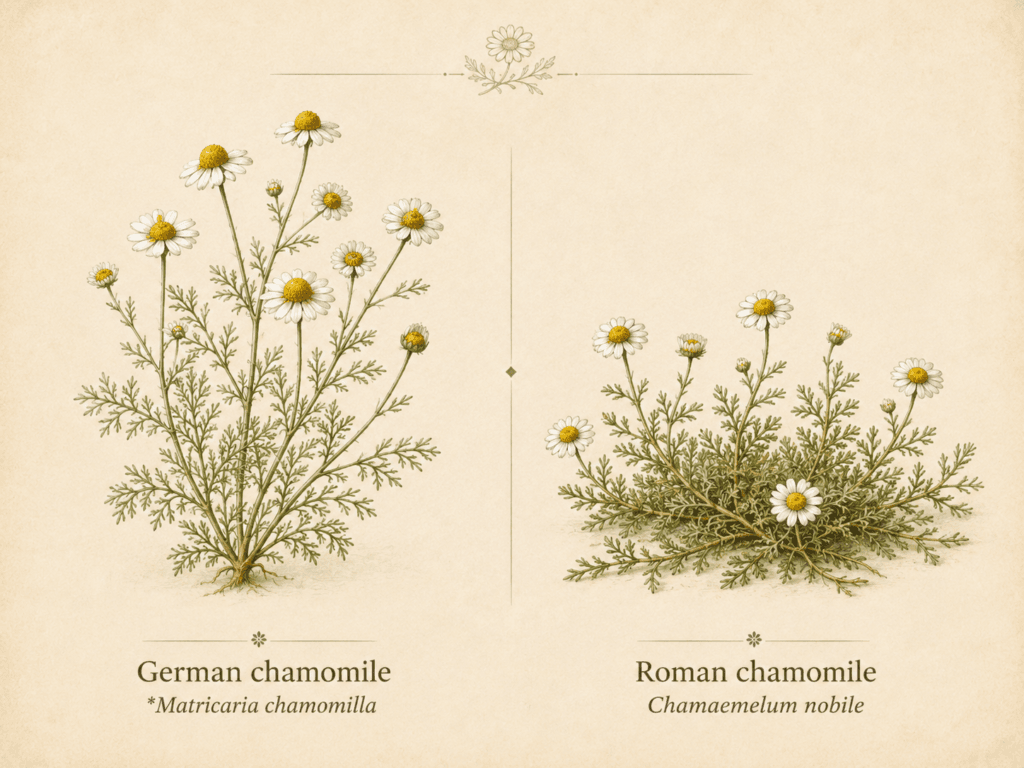
German Chamomile and Roman Chamomile Are Not the Same Plant
Two plants are commonly associated with the name chamomile:
Matricaria chamomilla — German chamomile
and
Chamaemelum nobile — Roman chamomile.
They are both members of the Asteraceae family, but they belong to different genera and are recognized as separate botanical species. Kew lists Matricaria chamomilla and Chamaemelum nobile independently.
This article discusses German chamomile.
That distinction becomes particularly important when medicinal effects are discussed, because evidence obtained with one species should not automatically be transferred to another.
What Is Chamomile Traditionally Used For?
The answer is more nuanced than a simple list of “benefits.”
For Matricaria chamomilla, European herbal-medicine documentation recognizes several applications based on long-standing traditional use.
These include minor gastrointestinal complaints such as bloating and mild spasms, as well as specific preparations used for minor inflammation of the mouth and throat and certain skin conditions.
Other very popular uses — particularly anxiety and sleep — have also been investigated scientifically.
However, the amount and quality of evidence vary considerably depending on the condition and preparation.
Chamomile and Digestive Comfort
Digestive use is one of the better documented traditional applications of German chamomile.
The EMA recognizes matricaria flower medicines for the traditional treatment of symptoms associated with minor gastrointestinal complaints, including bloating and mild spasms.
The word minor is important.
Chamomile should not be presented as a treatment for unexplained or persistent abdominal pain, gastrointestinal disease or other significant digestive symptoms.
When symptoms are severe, recurrent or persistent, identifying the underlying cause is more important than simply trying to suppress the discomfort.
Chamomile, Relaxation and Anxiety
Chamomile has a strong cultural association with calm and relaxation.
Modern research has gone further by investigating whether particular chamomile preparations might influence symptoms of anxiety.
The NCCIH reports that some research suggests chamomile extract may be helpful for generalized anxiety disorder, including clinical trials that observed reductions in anxiety symptoms. However, the agency characterizes these studies as preliminary and their findings as not conclusive.
This distinction is especially important for articles about herbal medicine.
The studies involved chamomile extracts prepared in specific ways.
They do not prove that:
a cup of chamomile tea treats an anxiety disorder.
Tea may still be part of a calming personal ritual. That is different from presenting it as a clinically established treatment.
Does Chamomile Help With Sleep?
Chamomile tea and bedtime are strongly linked in popular culture.
But being traditionally associated with sleep does not necessarily mean that something has been proven to treat insomnia.
According to the NCCIH, there is no conclusive evidence from clinical trials showing that chamomile is helpful for insomnia. Its broader chamomile review also notes that a 2019 review found only one study specifically addressing insomnia, and that study did not show a benefit for the disorder.
So the most accurate answer is:
Chamomile has a long tradition of use around relaxation and bedtime, but it should not be presented as a proven treatment for insomnia.
That leaves room for the ritual without turning tradition into a medical promise.
Chamomile for the Skin, Mouth and Throat
Chamomile has also traditionally been used externally.
The EMA recognizes certain matricaria flower preparations for minor inflammation of the mouth and throat and for several limited skin applications, including minor inflammation and superficial wounds. These indications apply to specific medicinal preparations and routes of use.
That last point matters.
A formulated mouth rinse, an ointment, a standardized extract and homemade chamomile tea are not automatically interchangeable.
The fact that one preparation has a documented use does not mean that any homemade preparation should be used in the same way.
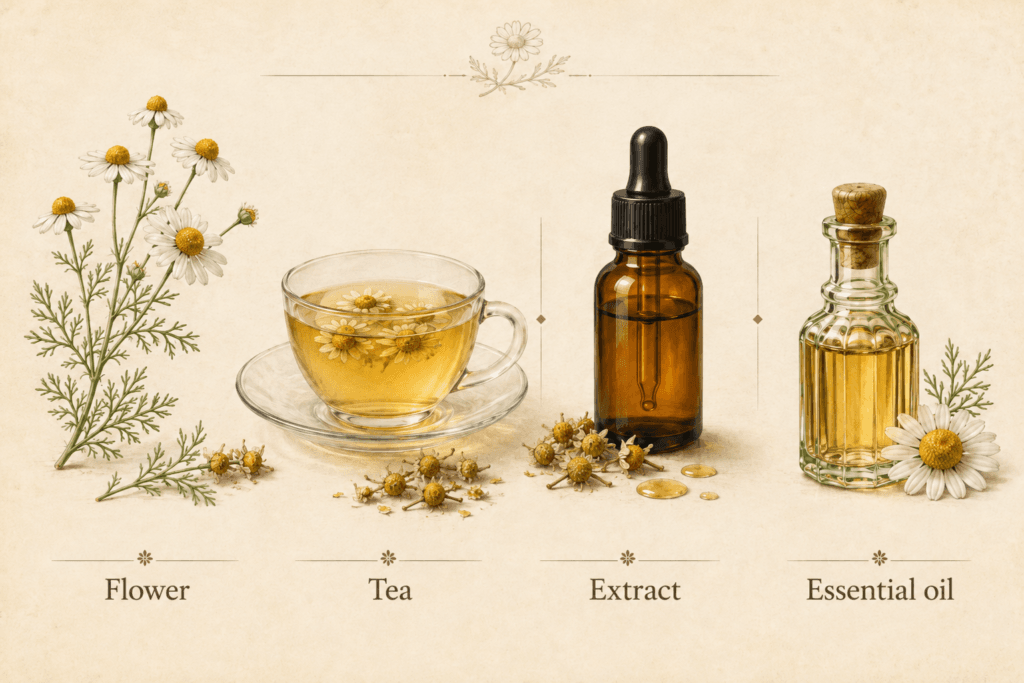
Flower, Tea, Extract and Essential Oil Are Not the Same
One of the simplest ways to misunderstand herbal research is to read:
“A study found that chamomile…”
without asking what the researchers actually used.
Chamomile flower preparations may exist as herbal teas, liquid or dry extracts and products for application to the skin or mouth. Essential oil preparations have their own composition and uses as well.
Dried flower heads
These are the plant material from which different preparations can be produced.
Herbal infusion
This is the familiar chamomile tea. Hot water extracts only part of the chemical constituents present in the flowers.
Extract
The extraction process, solvent and concentration can produce a chemical profile very different from a cup of tea.
Essential oil
This is the concentrated volatile fraction of the plant and is not chemically equivalent to either the flower infusion or a typical herbal extract.
Therefore:
evidence from a standardized chamomile extract should not automatically be presented as evidence for chamomile tea, and results involving essential oil should not automatically be transferred to either of them.
What Does Science Say About Chamomile?
Modern research presents a mixed and interesting picture.
The NCCIH states that studies examining chamomile for a range of specific conditions have not produced enough reliable evidence to rate its overall clinical usefulness. It also notes that some studies test products containing several herbs, which makes it difficult to determine chamomile’s individual contribution.
For generalized anxiety disorder, some studies of chamomile extracts have produced promising results, but they remain preliminary.
For insomnia, evidence remains insufficient and does not establish chamomile as an effective treatment.
For minor gastrointestinal complaints, the European regulatory position is based mainly on long-standing traditional use rather than strong clinical proof.
This means that the scientific answer to “Does chamomile work?” depends on a better question:
Which chamomile preparation, for which purpose, and supported by what kind of evidence?
Is Chamomile Safe?
Chamomile is generally well tolerated, but “natural” does not mean “risk-free.”
The NCCIH considers chamomile likely safe when consumed orally in amounts normally found in teas and foods. Reported adverse effects are uncommon but may include nausea, dizziness and allergic reactions. Severe hypersensitivity reactions, including anaphylaxis, have also been reported.
Allergy to Asteraceae
People who are allergic to related plants such as ragweed, chrysanthemums, marigolds or daisies are more likely to experience an allergic reaction to chamomile.
Medicines
Interactions involving warfarin and some medicines metabolized by the liver have been reported. There are also theoretical reasons to suspect interactions with other medicines, including sedatives.
Anyone taking regular medication should therefore discuss medicinal use of chamomile or concentrated herbal products with an appropriate health professional.
Pregnancy and Breastfeeding
Reliable information about the safety of medicinal chamomile use during pregnancy and breastfeeding is limited.
This makes self-directed regular medicinal use or concentrated preparations inappropriate without individual guidance.
Chamomile Near the Eyes
Homemade chamomile preparations should not be treated as eye drops.
The NCCIH notes that chamomile used near the eyes may cause irritation.
How to Use Chamomile Responsibly
A useful way to approach chamomile is to ask four questions before focusing on a claimed benefit:
Which species is it?
For this article, we are discussing Matricaria chamomilla.
Which preparation is it?
Tea, extract, topical preparation and essential oil are not equivalent.
What is it being used for?
A mild traditional digestive use is different from trying to treat persistent insomnia or an anxiety disorder.
What other factors matter?
Allergies, medicines, pregnancy, breastfeeding and persistent symptoms may change the safety assessment.
Responsible herbal use begins not with asking whether a plant is “good” or “bad,” but with understanding what exactly is being used and why.
Chamomile and the Language of Nature
There is something quiet about chamomile.
Its flowers are small.
Its aroma is familiar.
Its presence rarely asks for much.
And perhaps that is why it has found a place in so many ordinary rituals.
A plant does not need to promise everything to remain meaningful.
A warm infusion can simply mark a pause in a busy day. Learning about the plant can become another way of paying attention to the natural world.
Science does not take that away.
It simply helps us recognize the difference between what tradition remembers, what research suggests and what we can responsibly claim.
Frequently Asked Questions About Chamomile
What is chamomile good for?
German chamomile has traditional uses for minor digestive complaints and certain external applications. Specific chamomile extracts have also been studied for anxiety, but evidence varies depending on the preparation and condition.
Does chamomile help with sleep?
Chamomile is traditionally associated with bedtime and relaxation, but current clinical evidence does not establish it as an effective treatment for insomnia.
Can chamomile help with anxiety?
Some studies of specific chamomile extracts have reported promising results in generalized anxiety disorder, but the evidence remains preliminary and should not automatically be applied to chamomile tea.
Is chamomile safe to drink?
Chamomile is generally well tolerated in amounts commonly found in teas and foods. However, allergies, medicines and individual health circumstances can affect safety.
What is the best time to drink chamomile tea?
There is no medically established best time. Many people choose the evening because chamomile has a long cultural association with relaxation and bedtime.
Are German chamomile and Roman chamomile the same?
No. German chamomile is Matricaria chamomilla, while Roman chamomile is Chamaemelum nobile. They are different botanical species.
Explore Chamomile on Benverde
Chamomile can be explored from more than one perspective.
Camomila (Matricaria chamomilla): botânica, usos tradicionais e evidências científicas
A deeper look at the plant’s botany, composition, traditional uses and scientific evidence.
Para que Serve a Camomila? Usos tradicionais, evidências e cuidados
The Portuguese version of this practical guide.
Chá de Camomila: como preparar, usos tradicionais e cuidados
A dedicated article about the herbal infusion, preparation method and safety.
Most of Benverde is currently published in Portuguese, while selected articles are gradually being made available in English.
Conclusion
Chamomile is more than a herbal
So, what is chamomile good for?
The most accurate answer is not a long list of guaranteed benefits.
Matricaria chamomilla has a long history of traditional use, particularly for minor digestive complaints and certain external applications. Some standardized chamomile extracts have also produced interesting results in anxiety research, although the evidence remains preliminary. For insomnia, current clinical research does not justify presenting chamomile as a proven treatment.
That does not make chamomile less interesting.
It makes the plant more interesting.
There is the chamomile of traditional medicine, the chamomile investigated in laboratories and clinical studies, and the chamomile present in an ordinary cup at the end of a long day.
Understanding the difference allows all three to coexist without exaggeration.
Perhaps that is part of chamomile’s lasting appeal: it does not need to promise everything to have a meaningful place in everyday life.
Important Notice
This article is for educational purposes only and is not a substitute for diagnosis, treatment or individualized advice from a qualified health professional. Herbal products can cause adverse reactions and interact with medicines, and different preparations of the same plant are not necessarily equivalent

Criadora do Benverde, compartilho conteúdos sobre plantas medicinais, chás e vida natural com base em saberes tradicionais, observação prática e uso consciente. Acredito em um olhar sensível, responsável e conectado à natureza.
Também compartilho reflexões e conteúdos no LinkedIn.
This website is excellent, it provides interesting information on a good range of topics. I like how everything is neatly explained under very organised sub headings, exploring pretty much all information concerning the subject, for example, the one about Camomile tea. I’m glad there is a FAQ section and another one adressing the tea safety, it was really useful to me!
Thank you so much for your kind words 💚 It truly means a lot to know the content is helpful and easy to explore 🌿
I’m especially glad the FAQ and safety sections were useful to you — this care is very important to us at Benverde ✨